Outlining scenes in the Story Room
Hanging scenes off the spine, drafting them in versions, and what a scene has to answer.
This is where the outline actually gets written. Story Room → Scenes.
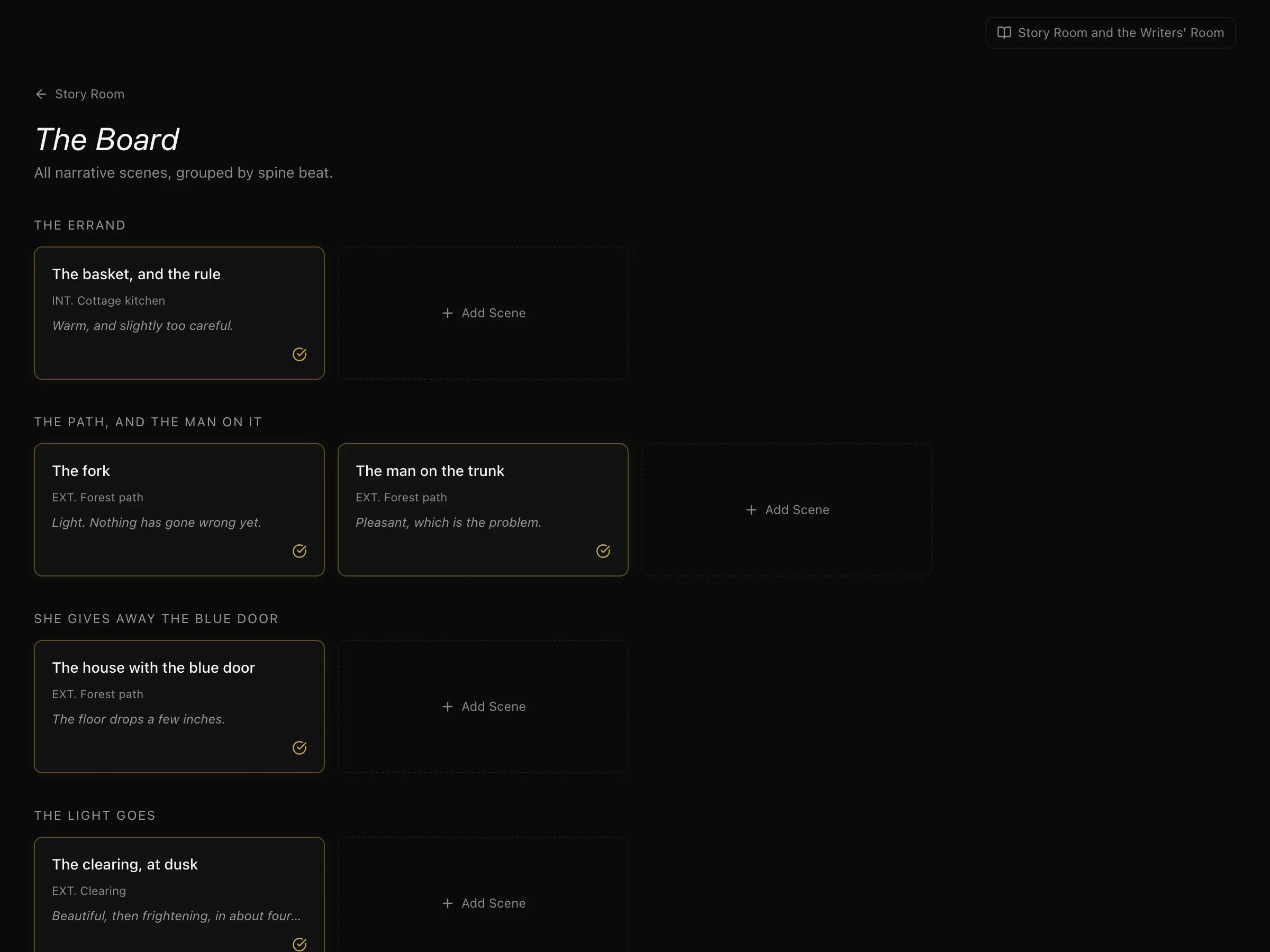
Every scene hangs off a spine node — you choose which beat it serves when you create it. That is not filing; it is the constraint that makes the spine useful. A scene you cannot attach to a beat is a scene that is not yet doing a job.
What a scene has to answer
Alongside title, venue, time of day and interior/exterior, each scene carries four fields that are worth more than the rest:
- Situation — where everyone is when it starts.
- Objective — what the character in the scene is trying to get.
- Conflict — what is in the way.
- Outcome — how it ends, and what is different because of it.
If you cannot fill in *conflict*, the scene is probably information rather than drama. If you cannot fill in *outcome*, nothing changed and the scene can usually be cut. Those two blanks are the most useful thing on the page.
There is also emotional pitch — how the scene should feel — which is what stops six well-constructed scenes in a row all feeling the same.
Drafts, without losing the last one
Scenes have versions. A scene starts with one, and you can create another whenever you want to try something without destroying what you had. One version is active at a time — that is the one the outline shows and the one that gets promoted — and you can switch which, or compare two side by side.
Use a new version when you are changing what the scene *does*, not when you are fixing a line.
Writing the scene
Inside a version, content is built from blocks:
- Action — what happens. - Dialogue — what someone says. A dialogue block must name the character speaking; that is what lets the product tell you who is actually in the film. - Internal — what they are thinking, for your benefit rather than the camera's. - Parenthetical, transition, and note.
Dialogue blocks also carry subtext and emotion — what is really being said underneath the line. That is a note to yourself and to the director, and it never appears in the script.
Who is in it
Assign characters to the scene. This is what populates the character's arc view and what the consistency check uses to notice a character who exists but never appears — or appears constantly and has no psychology filled in.
Next: threads, plants and payoffs — the connections between scenes.
More in Telling the Story
Didn't answer your question? Contact support.