The Payoff Sheet — plants, payoffs and the Story Map
How scenes connect, what you planted and never fired, and seeing the whole shape at once.
A list of scenes tells you the order. It does not tell you what connects to what — and that is where stories break.
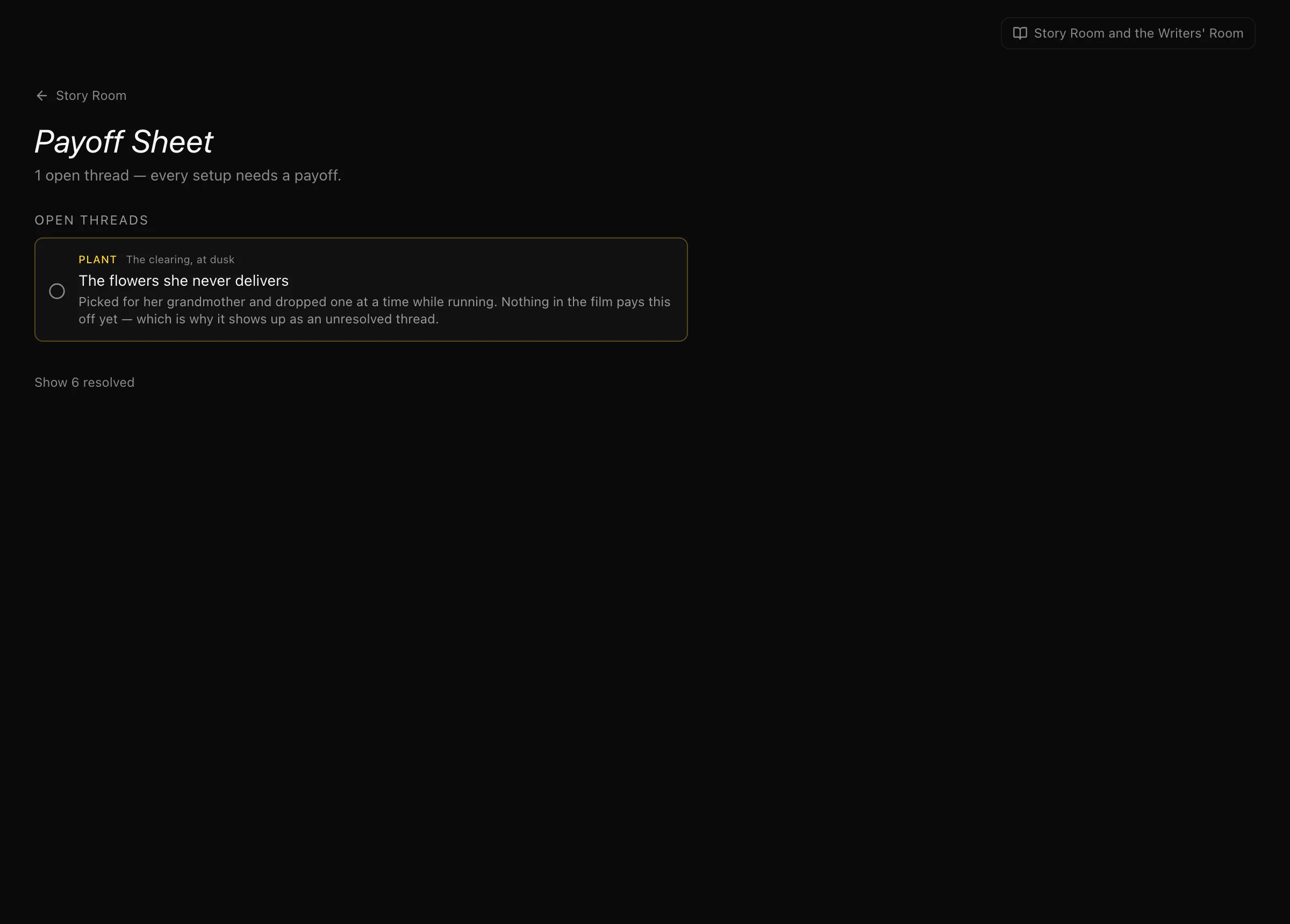
Story Room → Threads is where this lives. The product calls it the Payoff Sheet, which is the more honest name for what it does.
Links between scenes
Connect any two scenes with a link, and say what kind:
foreshadow · callback · parallel · contrast · echo · cause and effect · reveal · twist setup · twist payoff
Each link carries a description and a strength — subtle, moderate, or explicit. Strength is a note to yourself about how hard you are pointing at it. A foreshadow marked *explicit* that the audience still misses is a directing problem; one marked *subtle* that everyone spots is a writing problem.
Plants and payoffs
Where links join two scenes, events mark moments inside them:
setup · plant · twist · payoff · red herring · callback · reveal
The rule that makes this useful: a payoff, callback or reveal must point at the event it resolves. You cannot record a payoff without saying what it pays off.
That single constraint is what lets the product answer the question nobody can answer by reading: *what have I set up and never resolved?* Unresolved setups surface as warnings rather than waiting for a table read.
The Payoff Sheet
All of that surfaces on one screen — Story Room → Threads, titled Payoff Sheet. It opens on what is still open, because that is the list you actually need, with everything already resolved tucked behind a toggle.
An open thread is not a mistake. Some plants are meant to sit unresolved until a later draft, and some are deliberate ambiguity. The sheet does not tell you that anything is wrong — it tells you what you have not decided yet.
Consistency checks
Run a check on the whole project or a single scene. It looks for the things that are invisible while writing forwards:
- characters who appear in no scene at all
- scenes with nothing written in them
- setups with no payoff
- scenes not attached to any spine beat
- characters with no psychology filled in
- duplicate character names
None of these are errors exactly — plenty are deliberate. It is a list of things to have looked at.
The Story Map
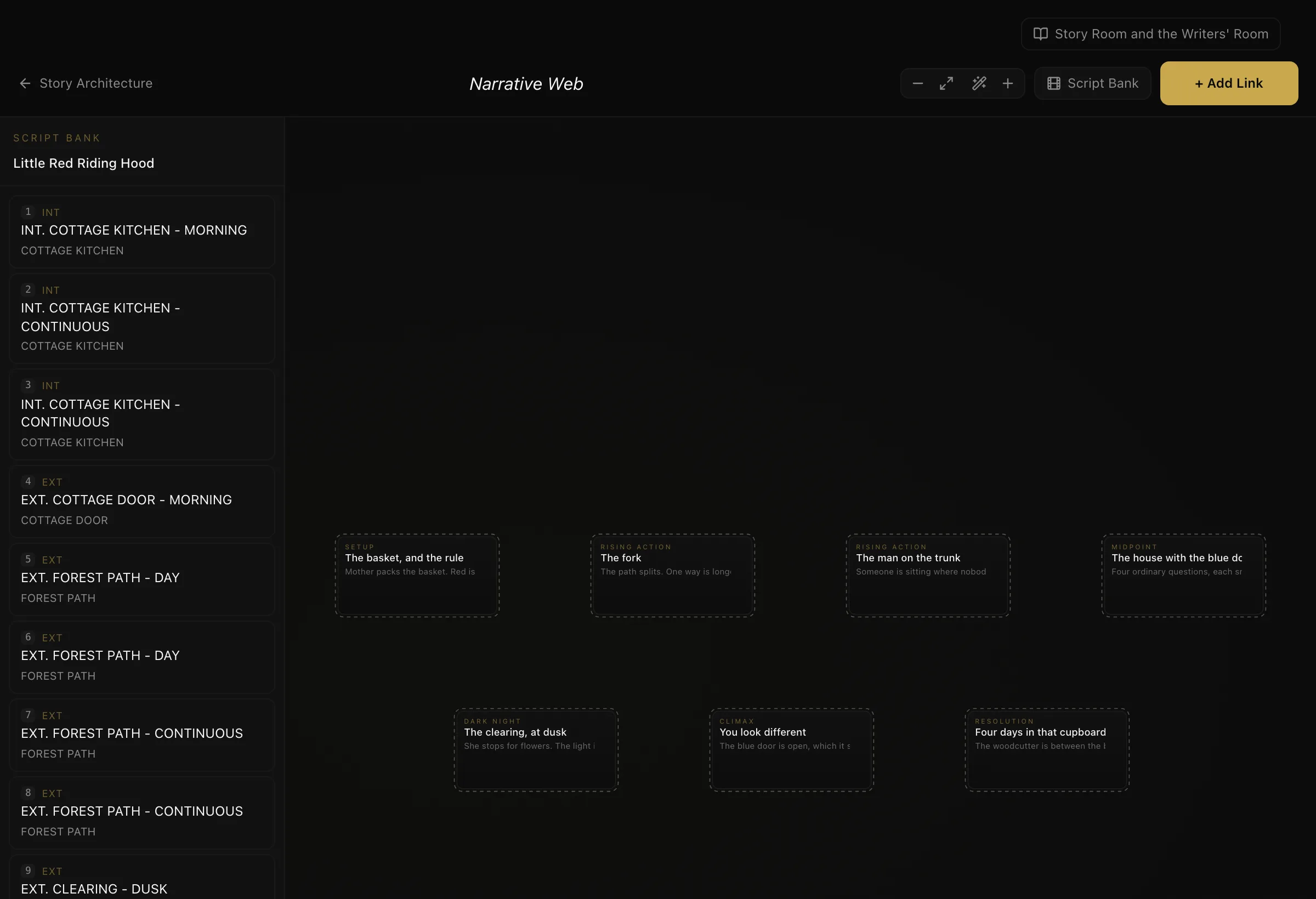
The Web view draws all of it: scenes as nodes, links as connections. It is the only place the shape of the story is visible rather than described.
What you are looking for is not tidiness. It is a scene with no connections at all, or a dense knot in one act and nothing in another.
Next: from story to script — turning this into something you can shoot.
More in Telling the Story
Didn't answer your question? Contact support.