Creating characters
Five questions that turn a name into a person, and how relationships are mapped.
Characters live in the Character Bible — open it from the project, or from the Story Room.
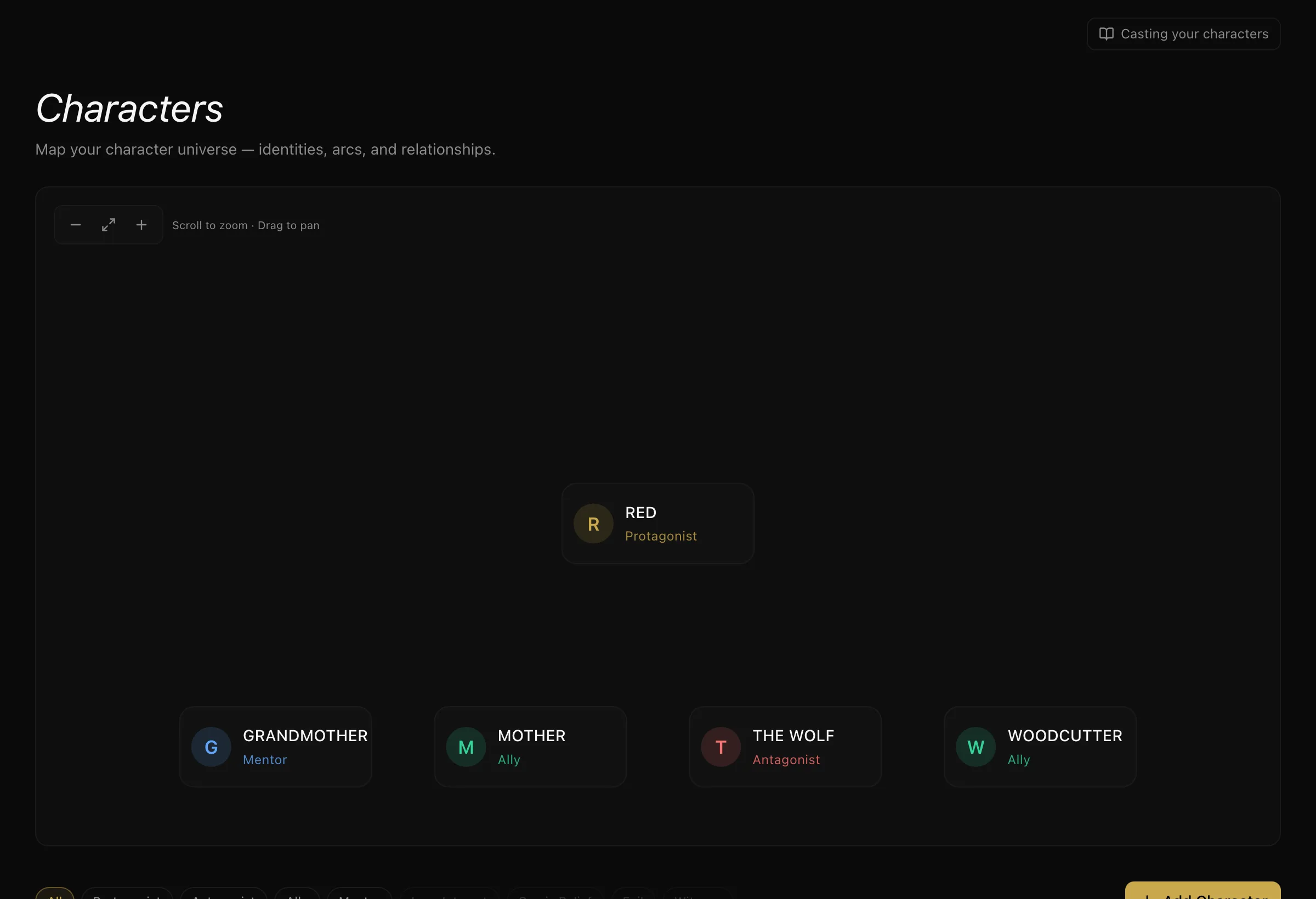
A character starts as a name and a role: protagonist, antagonist, ally, mentor, love interest, comic relief, foil, or witness. The role is how the character functions in the story, not how nice they are — a mentor can be wrong, and an antagonist does not have to be a villain.
The five questions
Underneath the name are five fields. They look like a writing exercise and they are not — they are the fields the consistency check reads, and the fastest way to find out that a character you have written nine scenes for does not actually want anything.
- Wound — what happened before the film started that still governs them. - Want — what they are pursuing on the surface. This drives the plot. - Need — what would actually help them. Usually not the same as the want, and the gap between the two is the arc. - Fear — what they will avoid at any cost. This is where your obstacles are. - Lie — what they believe that is not true. The climax is usually the moment it stops working.
Fill in *want* and *fear* first if you fill in nothing else. Between them they generate most of what a character does.
There is also arc summary (where they end up) and voice notes (how they speak — the thing that stops four characters sounding like one).
The rest of the profile
Age, gender, description, physical description, costume notes, a colour palette and reference images. These are not decoration: costume and palette are what the costume and art departments read later, and filling them here means not re-deciding them under pressure.
Relationships
Characters are connected, not listed. Each relationship has a category — family, romance, alliance, power, conflict, professional, or hidden — and a label in each direction, because relationships are rarely symmetrical. "She is his daughter" and "he is the man she is avoiding" can be the same relationship.
That two-sided labelling is the whole reason relationships are modelled rather than written in a notes field. A cast list cannot hold it.
Exporting
Any character can be exported as a PDF character sheet — profile, psychology, relationships and their scenes with dialogue excerpts. It is what you send an actor before a read-through.
Next: outlining your scenes — putting these people into the beats.
More in Telling the Story
Didn't answer your question? Contact support.