The spine — what it is and why you need one
Seven load-bearing beats, and what goes wrong without them.
The spine is the skeleton of your story: the handful of beats that carry its weight. Not every scene — the ones that, if you removed them, would leave the film standing on nothing.
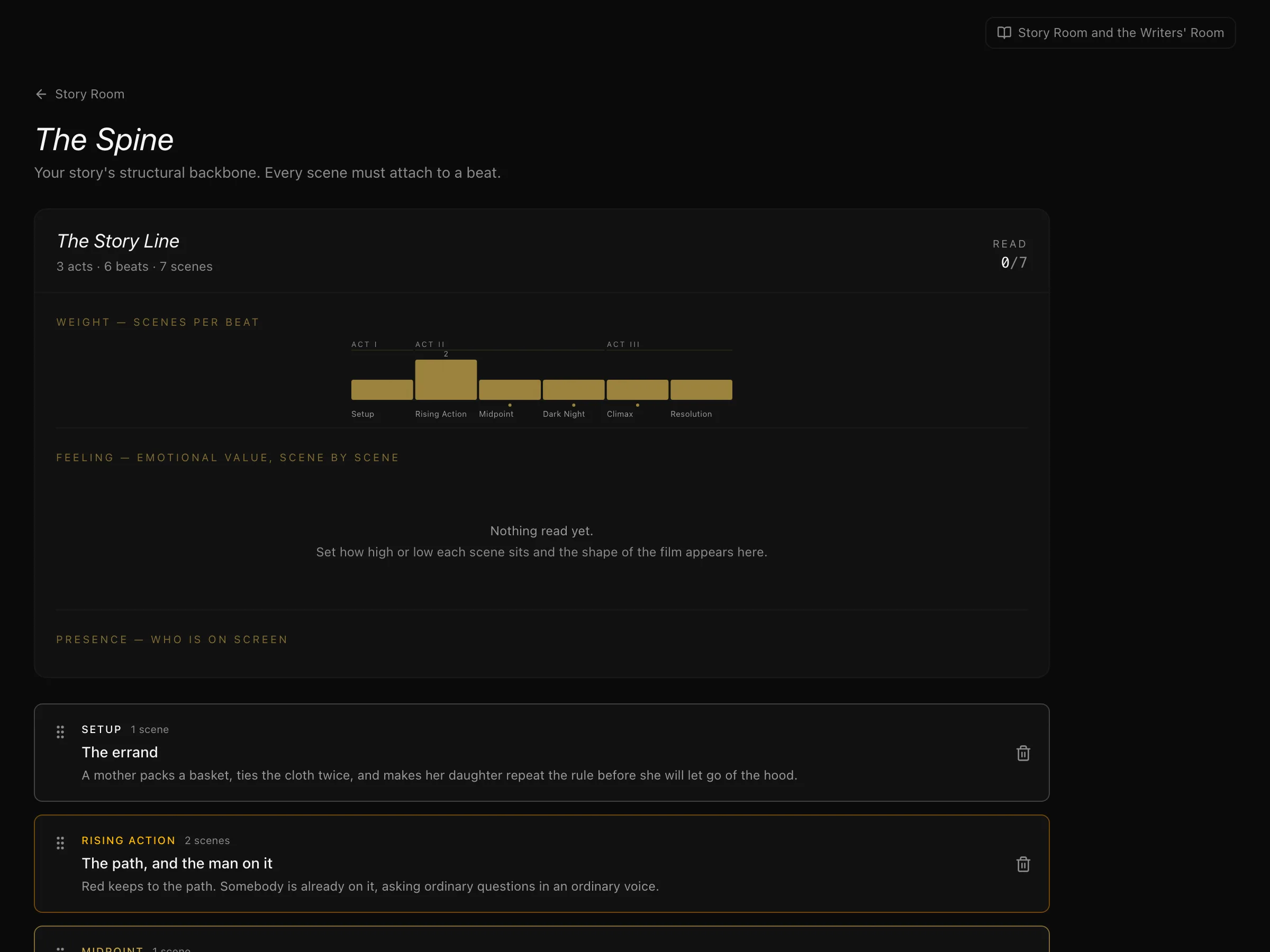
The seven beats
Story Room → Spine. Each node has a type:
- Setup — the world as it is, and what is wrong with it.
- Rising action — pressure increases; the cost of doing nothing goes up.
- Midpoint — the story turns. What the audience thought it was about shifts.
- Twist — an assumption breaks.
- Dark night — the lowest point. Whatever the protagonist has been relying on stops working.
- Climax — the confrontation the whole film has been arranging.
- Resolution — the world as it is now, and what changed.
You are not obliged to use all seven, and you can have more than one of a type — most films have several rising-action beats.
Why bother, if you already know the story
Two reasons, and both are about what you cannot see while writing forwards.
It tells you where the story is thin. Scenes attach to spine nodes. When eleven scenes hang off "rising action" and one off "climax", you are looking at a film that spends an hour arranging a confrontation it then rushes. You would not notice that reading the outline top to bottom.
It survives rewriting. Scenes get cut, merged and reordered constantly. Beats rarely do. Keeping them separate means a rewrite is moving scenes between beats rather than losing your grip on the shape.
Ordering
The order of the nodes is the order of the film. Use the up and down arrows on a beat to move it earlier or later.
Required and optional beats
Every beat starts Required. A required beat with no scenes attached is flagged in the Story Room's notes — a climax nobody has written yet is worth being reminded of. Press Required on a beat to make it Optional when the film genuinely does without it; an optional beat is never flagged for being empty.
Next: creating your characters — the people the beats happen to.
More in Telling the Story
Didn't answer your question? Contact support.