Your premise, and why it gets locked
The one line the whole film is measured against — and what the Compass asks for.
The premise is your film in one sentence. Not a summary, not a pitch — the irreducible thing that makes it this film and not another one.
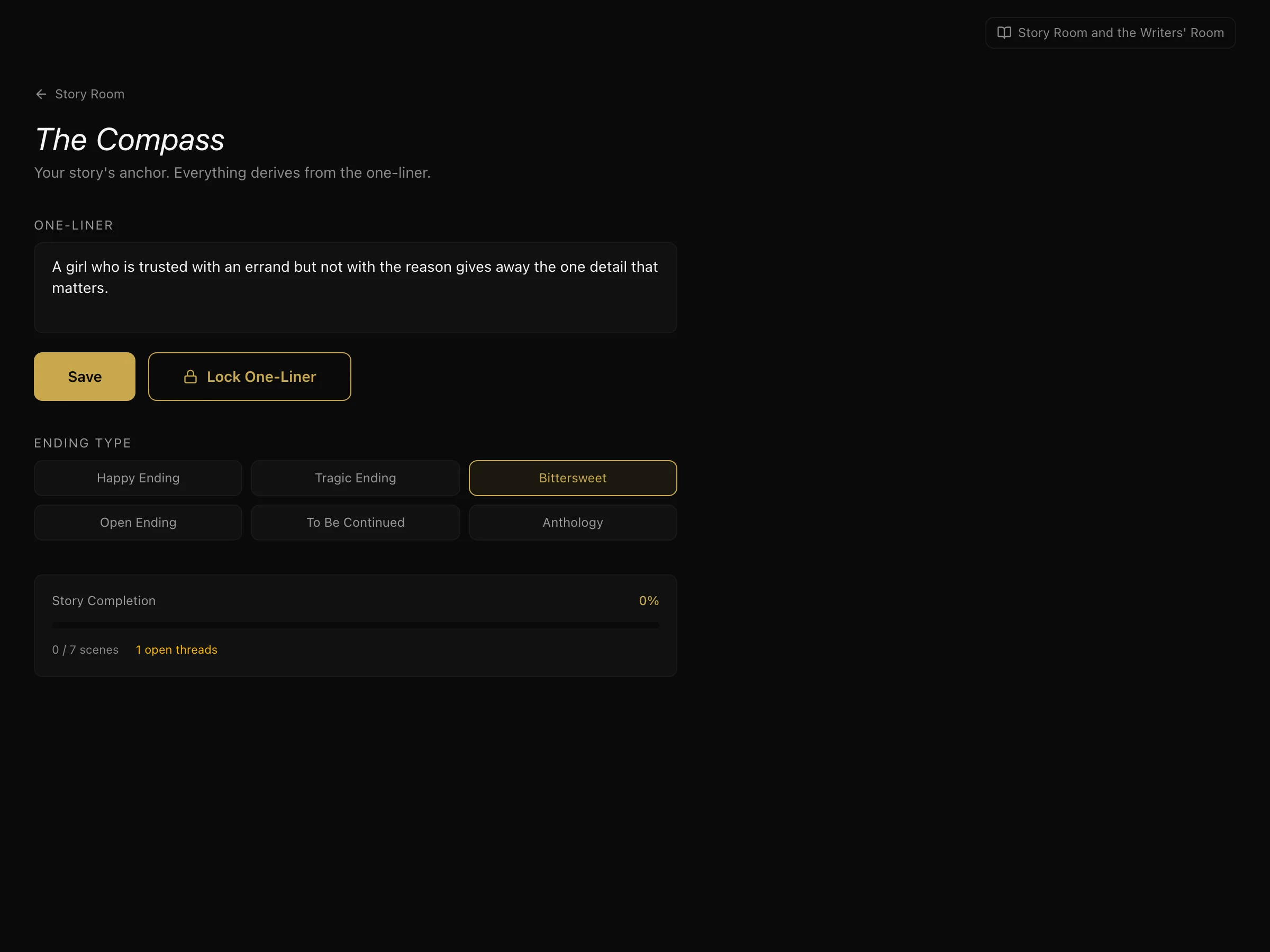
It is the first thing the Story Room asks for, and the only thing it lets you lock.
Why one line
Because a premise you cannot say in one line is usually two films, or none. The discipline is the point: if the sentence needs an "and also", something in the story is not carrying its weight yet.
It is also the thing you will check every later decision against. A scene that does not serve the premise is not necessarily a bad scene — but you should have to notice you are keeping it.
What the Compass asks for
Open Story Room → Compass. Alongside the one-liner:
- Logline — the longer version, the one that goes in an email. - Theme — what the film is *about*, underneath what happens. - Genre and tone — genre sets expectations; tone sets how you meet them. - Ending type — happy, sad, bittersweet, open, part two, or anthology. Choosing this early is uncomfortable and useful: most story problems are really disagreements about the ending that nobody has had out loud yet. - Constraints — what you already know you cannot do. One location, no night exteriors, a cast of three. Constraints written down early are a shape; discovered late they are a crisis.
Locking
Once you are sure, you can lock the one-liner.
Locking is deliberate and it is permanent — there is no unlock. That sounds harsh for a text field, and it is the point: the premise is the one thing that should stop moving once the work starts. If it is still moving, the film is still being decided, and locking it is a way of saying out loud that it is not.
Everything else on the Compass stays editable. Only the one line is final.
Next: the story spine — the beats that carry the premise from beginning to end.
More in Telling the Story
Didn't answer your question? Contact support.